
Acute limb ischemia: let viability, not the clock alone, guide urgency
A practical, evidence-based surgical review
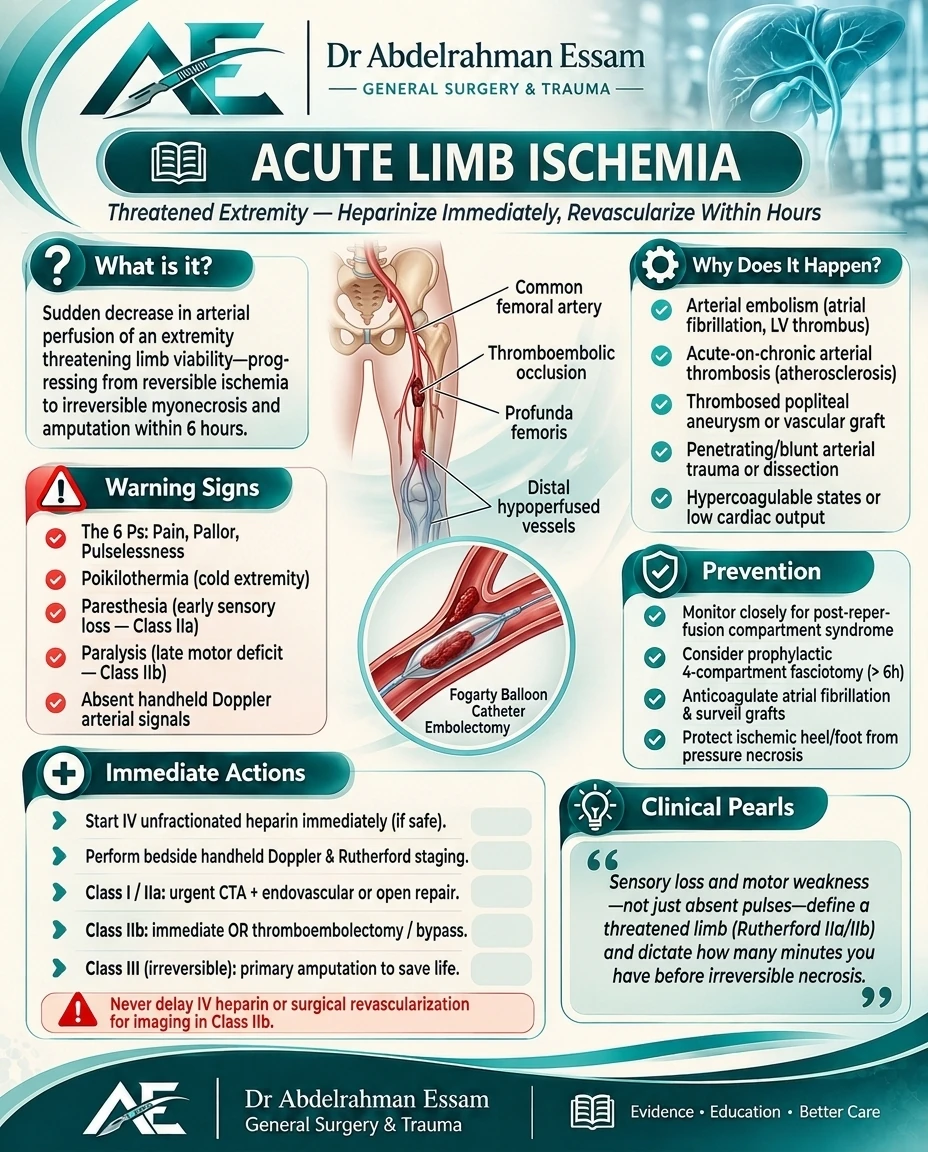
Sensory and motor findings help distinguish a viable limb from one requiring immediate reperfusion. Six hours is not a universal biological deadline.
Recognize the threatened limb
Acute limb ischemia is an abrupt reduction in perfusion that threatens viability. Pain, pallor, coolness, absent pulses, paresthesia, and weakness are familiar signs, but not every patient has all of them.
Examine both limbs and assess arterial and venous Doppler signals, sensation, and motor function. Prompt vascular specialist involvement is essential.
[1,2]
Stage the ischemia
Rutherford class I describes a viable limb. Class IIa is marginally threatened, generally without motor deficit.
Class IIb is immediately threatened and requires emergency reperfusion. Profound sensory and motor loss with other findings can indicate class III irreversible ischemia.
This classification depends on skilled clinical assessment, not simply a missing pedal pulse. [1,2]
Begin treatment while planning reperfusion
Systemic unfractionated heparin is generally started unless contraindicated, alongside analgesia and supportive care. Imaging should inform treatment without creating harmful delay.
Rapid duplex or angiography may be useful even in severe ischemia if immediately available; the rule is to avoid delaying reperfusion, not to forbid all imaging in class IIb. [1,2]
Choose the fastest appropriate strategy
Open, endovascular, and hybrid treatments are selected according to cause, anatomy, severity, expertise, and time to restore flow. A fixed six-hour threshold cannot reliably determine whether a limb is salvageable, and class IIb does not mean open surgery is the only possible treatment.
Irreversible ischemia requires careful specialist decision-making because reperfusion may create life-threatening systemic injury. [1,2]
Anticipate reperfusion injury
After flow is restored, monitor perfusion, neurology, potassium, renal function, and compartment syndrome. Fasciotomy may be necessary or considered prophylactically in high-risk circumstances, but it should not be triggered solely by crossing a six-hour mark.
Investigate the source and plan secondary prevention to reduce recurrent events. [1,2]
Practical Surgical Pearls
- Document motor and sensory findings before and after revascularization.
Common Pitfalls
- Treating six hours as a guaranteed safe period or an automatic point of futility.
Key Takeaways
- Stage rapidly, prevent propagation when appropriate, and restore flow without avoidable delay.
References
Educational content for healthcare learners and professionals, not individualized medical advice. Sources checked 22 November 2026. Recommendations may change; consult the full source and current local guidance. This is an editorial evidence review, not independent clinical peer review.