
Pain out of proportion: an acute mesenteric ischemia case discussion
Hypothetical case with guideline-based discussion
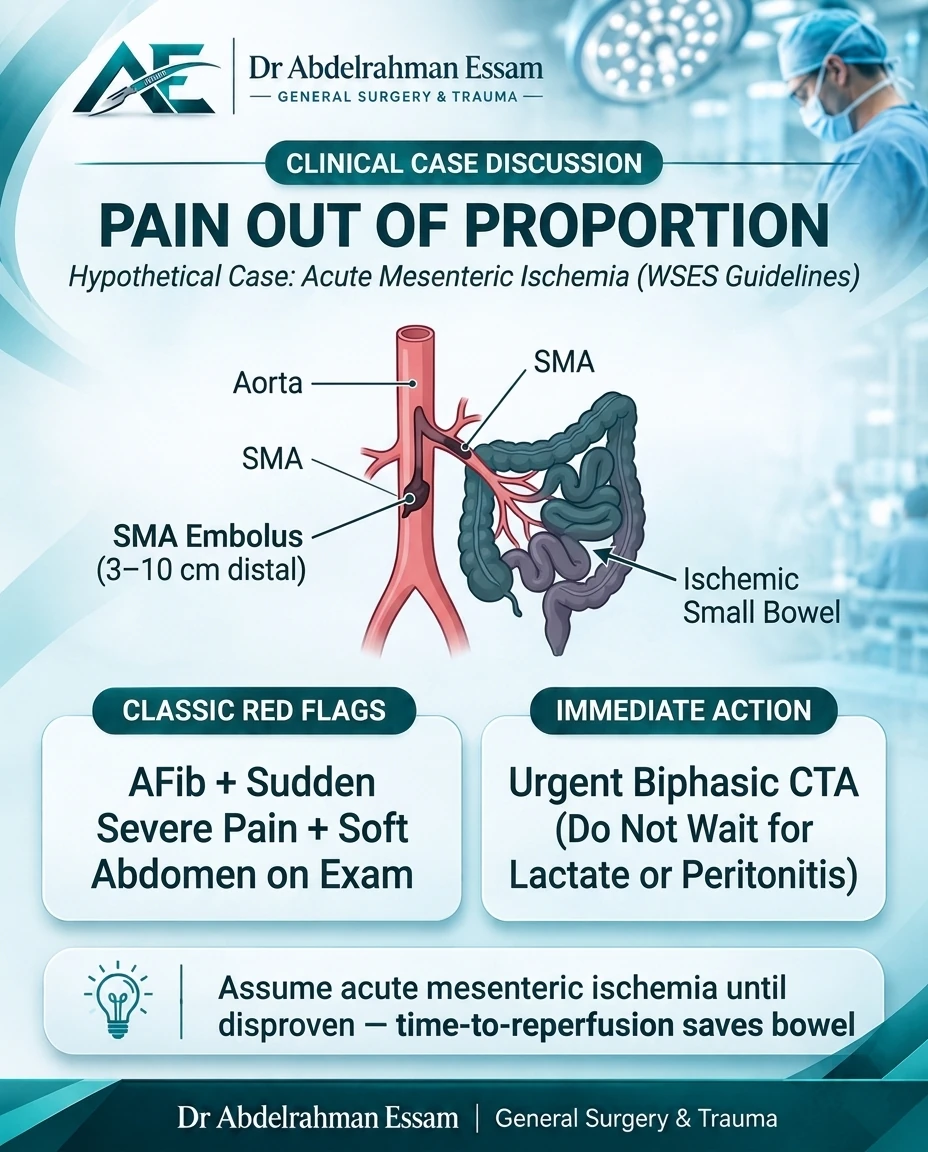
A hypothetical case illustrates why an initially soft abdomen and a normal lactate must not delay urgent vascular imaging.
Hypothetical educational scenario
A 74-year-old patient with atrial fibrillation develops sudden severe abdominal pain, but the first examination shows little tenderness. This is a constructed teaching case, not a report of a patient treated by Dr Abdelrahman.
The mismatch between symptoms and examination should raise concern for acute mesenteric ischemia, while other time-critical causes remain in the differential. [1]
Reason through the differential
Mesenteric arterial embolism is a concern with atrial fibrillation. Other possibilities include arterial thrombosis, non-occlusive ischemia, mesenteric venous thrombosis, aortic catastrophe, perforation, pancreatitis, and strangulated obstruction.
A soft abdomen early in the course is not reassuring enough to end the investigation. Peritoneal signs may signal advanced disease. [1]
The decisive investigation
WSES recommends CT angiography without delay when AMI is suspected. A normal lactate does not exclude early intestinal ischemia, and no routine blood test reliably rules it out.
The guideline advises against allowing acute kidney injury to delay necessary CTA when the clinical suspicion is substantial, because missed bowel ischemia can be catastrophic. [1]
Resuscitation and treatment happen in parallel
Urgent surgical and vascular involvement, perfusion assessment, careful fluid resuscitation, and broad-spectrum antibiotics accompany diagnosis. Anticoagulation is considered according to cause and bleeding risk.
Arterial occlusion may require endovascular, open, or hybrid reperfusion; venous thrombosis without peritonitis is often managed initially with anticoagulation. These pathways are not interchangeable. [1]
If the abdomen becomes peritonitic
Peritonitis requires urgent operative assessment for non-viable bowel. Revascularization and bowel preservation must be coordinated.
When viability remains uncertain, temporary abdominal closure and planned reassessment can help avoid both missed necrosis and unnecessary resection. The clinical aim is the shortest safe time to diagnosis and effective treatment, not completion of a rigid sequence. [1]
Practical Surgical Pearls
- Severe unexplained pain with minimal early findings is a reason to investigate, not to dismiss symptoms.
Common Pitfalls
- Waiting for lactate elevation or guarding before ordering CTA.
Key Takeaways
- Recognize the pattern early and coordinate a cause-specific treatment pathway.
Educational content for healthcare learners and professionals, not individualized medical advice. Sources checked 22 November 2026. Recommendations may change; consult the full source and current local guidance. This is an editorial evidence review, not independent clinical peer review.