
Antibiotics after source control: what STOP-IT changed
A practical, evidence-based surgical review
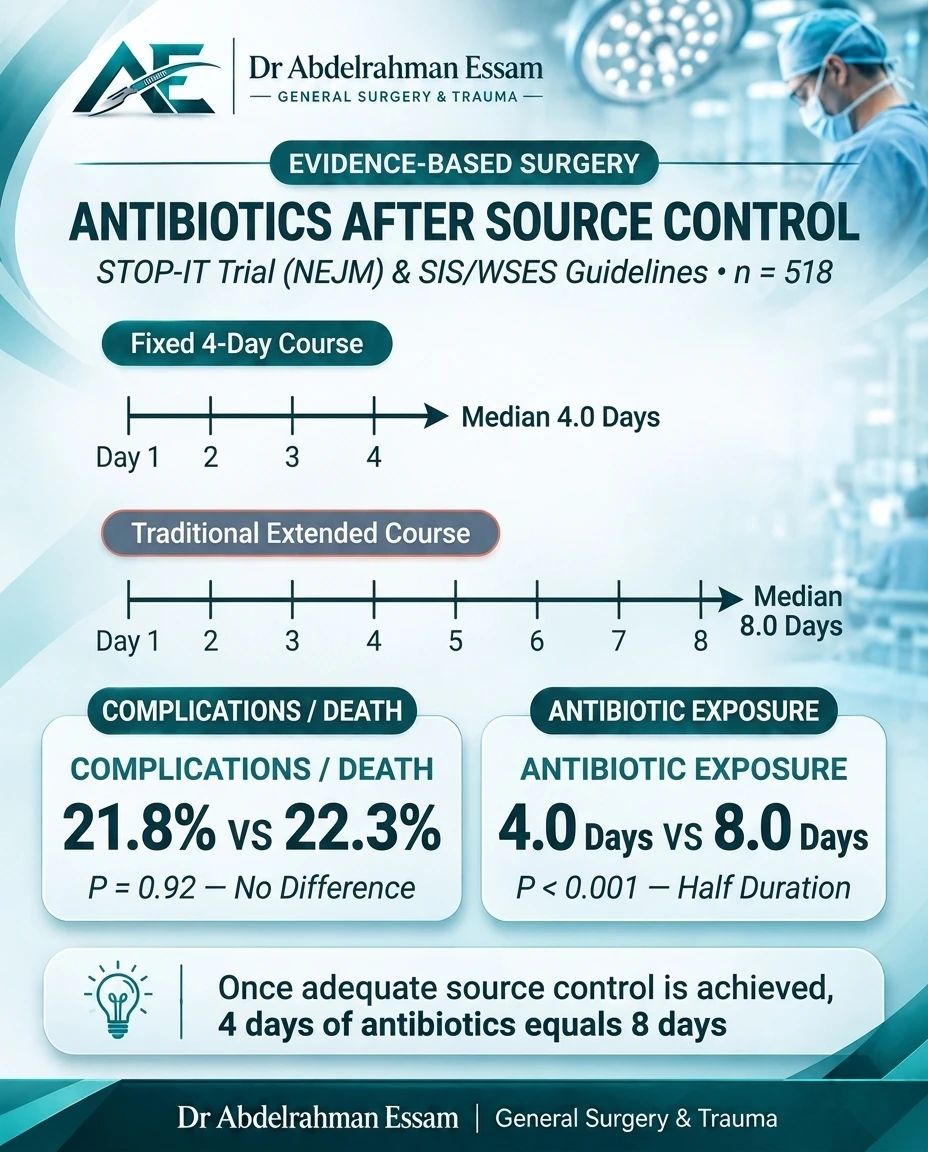
A shorter course worked as well as a longer strategy in the trial population. The key condition was adequate source control.
Begin with source control
In complicated intra-abdominal infection, antimicrobial treatment cannot drain an abscess, close a continuing bowel leak, or remove devitalized tissue. Decisions about duration must begin with whether the anatomical source has been adequately controlled.
The shorter-course evidence is not permission to ignore a persistent source. [1]
The randomized comparison
STOP-IT enrolled 518 patients with complicated intra-abdominal infection who had undergone adequate source control. One strategy used approximately four days of antibiotics; the other continued treatment until two days after resolution of fever, leukocytosis, and ileus, up to a defined maximum.
Median exposure was four days versus eight days. [1,2]
The main result
The composite of surgical-site infection, recurrent intra-abdominal infection, or death occurred in 21.8% (56/257) of the short-course group and 22.3% (58/260) of the longer-course group. The trial did not show an advantage from extending antibiotics in this population.
The outcome-specific denominators should be preserved rather than forced to equal the enrollment total. [1,2]
Persistent illness needs a fresh assessment
Ongoing fever, organ dysfunction, pain, or inflammatory abnormalities should prompt reassessment of the whole clinical picture, including an undrained collection, ongoing leak, resistant organism, or another diagnosis. The response should not be an automatic extension of the same prescription.
Timing and imaging depend on the patient; deterioration warrants urgent review. [1,2]
Keep the boundary visible
This trial does not establish one duration for every infection or every host. Inadequate source control, another infectious focus, bacteremia, immunosuppression, or a pathogen-specific indication may require a different plan.
Choice of agent, cultures, local resistance, and renal function remain important. Record both the source-control assessment and the intended stop or review date.
[1,2]
Practical Surgical Pearls
- Put an antibiotic review date in the plan when source control is achieved.
Common Pitfalls
- Using extra antibiotic days as a substitute for investigating ongoing sepsis.
Key Takeaways
- Shorter exposure is evidence-based when the clinical and source-control conditions fit.
Educational content for healthcare learners and professionals, not individualized medical advice. Sources checked 22 November 2026. Recommendations may change; consult the full source and current local guidance. This is an editorial evidence review, not independent clinical peer review.