
Appendiceal abscess and phlegmon: an updated decision pathway
A practical, evidence-based surgical review
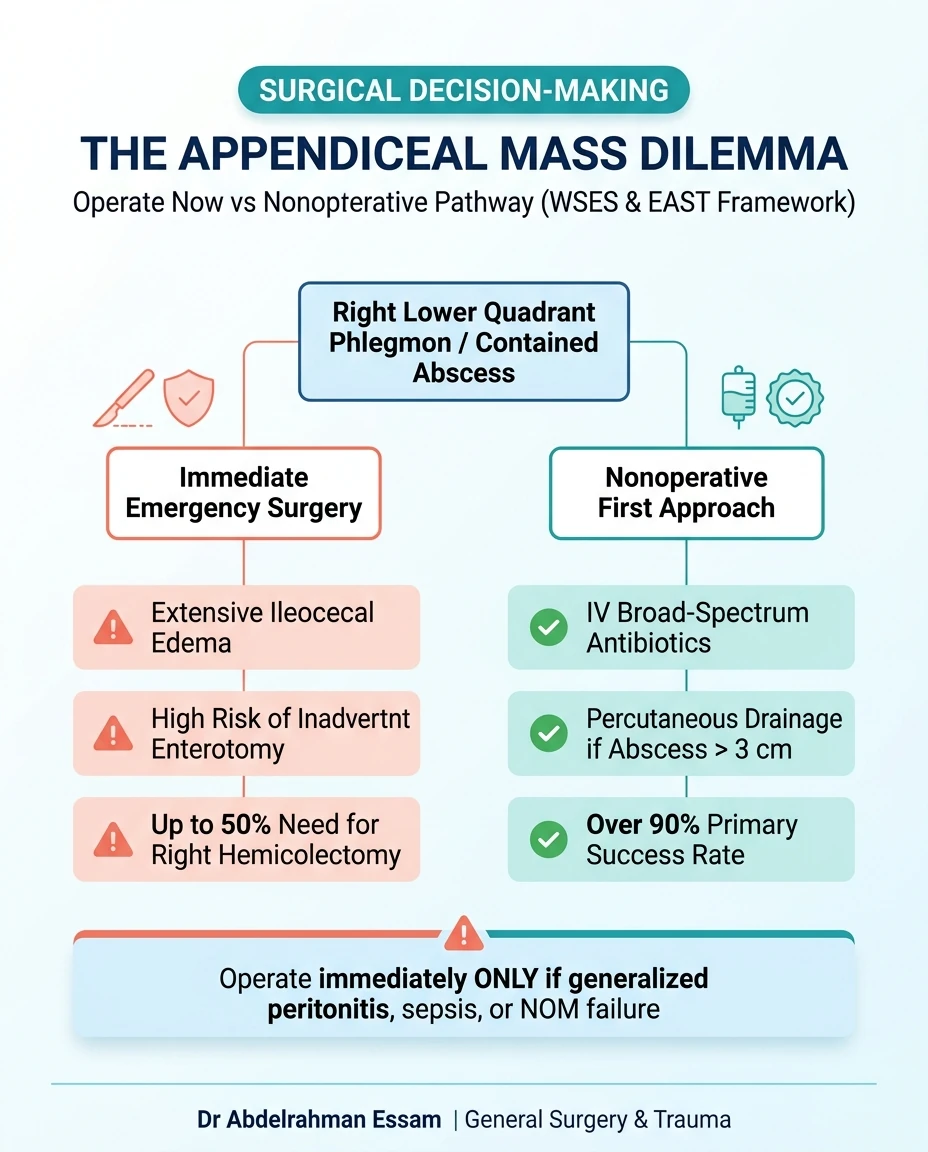
The 2025 WSES update changes the age-based abscess pathway and interval-appendectomy advice. Do not apply an older rule to every inflammatory mass.
Define the inflammatory mass
An inflammatory mass may be a phlegmon without a drainable cavity or a periappendicular abscess. Imaging, physiology, and the presence of generalized peritonitis determine the immediate problem.
An abscess pathway must not be applied indiscriminately to uncomplicated appendicitis or to every phlegmon. The 2025 WSES Jerusalem guideline was published in January 2026 and updates the earlier 2020 advice.
[1,2]
Initial care and source control
Stable patients with contained disease may receive antibiotics, with image-guided drainage when a collection is suitable and the overall plan supports it. A phlegmon cannot be drained as if it were a fluid cavity.
Generalized peritonitis, instability, or clinical deterioration requires urgent source-control assessment rather than waiting for an arbitrary observation period. [1,2]
The updated adult abscess pathway
For adult patients younger than 35 with complicated appendicitis and periappendicular abscess, the 2025 guideline suggests early laparoscopic appendectomy when appropriate expertise and resources are available. Initial nonoperative management followed by interval surgery is an alternative in settings lacking that capability.
For patients aged 35 or older with this abscess presentation, it suggests against early appendectomy because of the risk of underlying appendiceal neoplasm. This does not justify delaying emergency treatment of uncontrolled sepsis. [1]
Interval appendectomy is not one rule for everyone
After initial nonoperative management of a periappendicular abscess in adults aged 35 or older, recommendation 14.1 recommends interval appendectomy between 6 and 12 weeks to reduce the risk of a missed appendiceal neoplasm. This is a material change from simply repeating the older advice against routine interval surgery in younger adults.
Pediatric recommendations differ and should not be transferred to adults. [1]
Make the follow-up explicit
Document the imaging findings, initial treatment, specialist review, and the plan to exclude neoplasm and complete follow-up. Persistent symptoms, a residual mass, or recurrent illness require reassessment.
Decisions about colonic investigation, repeat imaging, and surgery must be linked to age, the abscess presentation, and the treating team pathway. Read the current recommendation in full rather than using an isolated age threshold as a substitute for clinical judgment.
[1,2]
Practical Surgical Pearls
- Distinguish a phlegmon from an abscess before choosing the pathway.
- Check the guideline edition: the 2025 update changes interval-surgery advice.
Common Pitfalls
- Repeating the old under-40 no-interval-surgery rule as if it covers all current adult abscess care.
- Delaying emergency source control because an elective interval pathway was planned.
Key Takeaways
- Use the current age- and presentation-specific pathway, with a documented neoplasm and follow-up plan.
References
Educational content for healthcare learners and professionals, not individualized medical advice. Sources checked 22 November 2026. Recommendations may change; consult the full source and current local guidance. This is an editorial evidence review, not independent clinical peer review.