
Bile duct injury: recognize, define, and refer safely
A practical, evidence-based surgical review
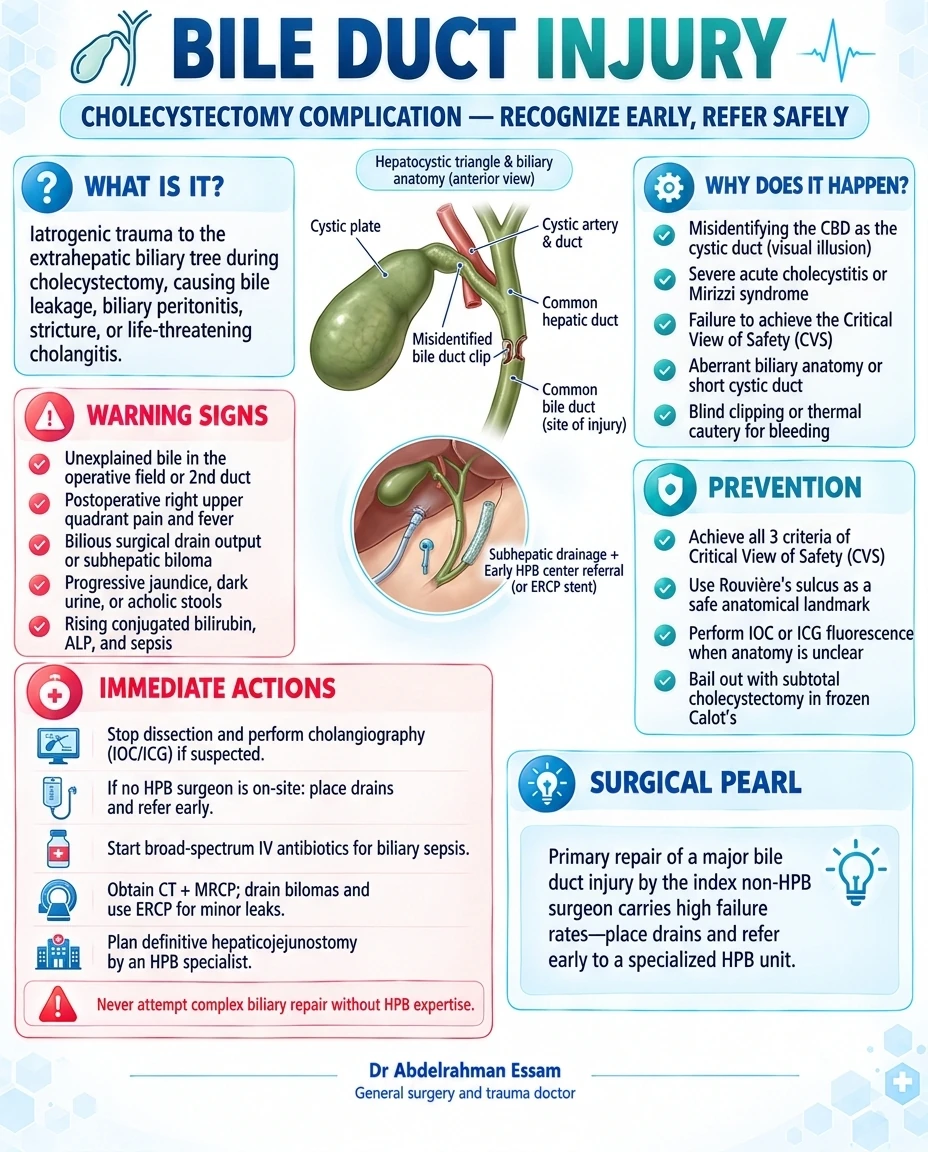
Uncertain anatomy and a difficult postoperative recovery need a deliberate response, not further blind dissection or an improvised major repair.
Prevention begins with identification
During cholecystectomy, misidentification of anatomy is a major mechanism of bile duct injury. The critical view of safety requires clearance of the hepatocystic triangle, separation of the lower gallbladder from the cystic plate, and confirmation that only two structures enter the gallbladder before division.
If this cannot be achieved safely, a bailout strategy should be considered. [1]
Recognize an unexpected course
Postoperative pain, fever, distension, bilious drainage, jaundice, or failure to recover as expected warrants investigation. Leakage and obstruction can present differently, and absence of marked jaundice does not exclude a leak.
Laboratory trends, contrast-enhanced CT, MRCP, and selected invasive studies are used according to the suspected problem. [1]
When injury is suspected during surgery
Stop and define the anatomy rather than adding clips or dissection blindly. Intraoperative imaging and an experienced opinion may help.
Management depends on injury type, associated vascular injury, contamination, and available expertise. When appropriate hepatopancreatobiliary expertise is absent, drainage, stabilization, documentation, and early referral are safer than an unfamiliar complex reconstruction. [1]
Control sepsis before definitive reconstruction
Collections may need percutaneous drainage. Selected minor leaks can be managed endoscopically when duct continuity permits, whereas major transections or complex injuries may require specialist reconstruction.
Not every Strasberg category is managed identically, and ERCP is not a universal solution when the proximal duct is disconnected. [1]
Choose timing with the specialist team
The timing and form of definitive repair depend on when the injury is recognized, the inflammatory state, vascular involvement, and expertise. Early referral does not mean every patient needs immediate reconstruction.
Record the operative findings and available imaging accurately so the receiving team can plan care without repeating harmful attempts at repair. [1]
Practical Surgical Pearls
- When anatomy is uncertain, pause before dividing another structure.
Common Pitfalls
- Treating fluorescence imaging as a guarantee against injury.
- Attempting an unfamiliar major biliary reconstruction before specialist advice.
Key Takeaways
- Early recognition and a planned specialist pathway protect future reconstructive options.
References
Educational content for healthcare learners and professionals, not individualized medical advice. Sources checked 22 November 2026. Recommendations may change; consult the full source and current local guidance. This is an editorial evidence review, not independent clinical peer review.