
Boerhaave syndrome: recognize perforation and control contamination
A practical, evidence-based surgical review
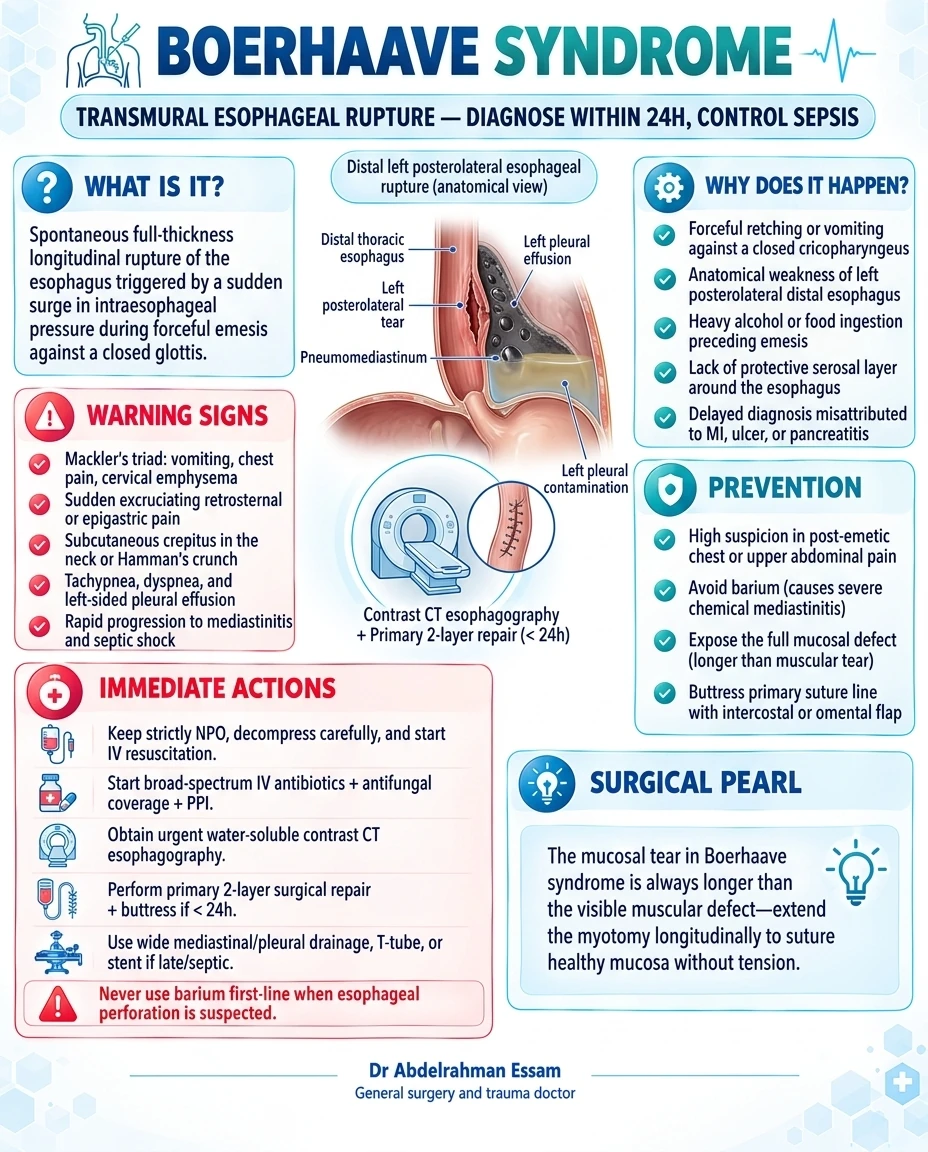
Chest pain after forceful vomiting warrants a broad emergency assessment. Treatment of esophageal perforation depends on physiology, containment, and expertise.
The warning pattern
Boerhaave syndrome is a spontaneous full-thickness esophageal rupture, often following forceful vomiting. Chest or upper abdominal pain, dyspnea, sepsis, or subcutaneous emphysema may occur.
The full classic triad is frequently absent, so it must not be required for diagnosis. Acute coronary syndromes, aortic disease, pulmonary embolism, and other emergencies remain important alternatives.
[1,2]
Define the leak and its consequences
Contrast-enhanced CT and CT esophagography can help identify perforation and mediastinal or pleural contamination. Water-soluble contrast studies may be useful in selected patients.
If an initial study is negative but suspicion remains, further investigation is needed. A specialist may select additional imaging, including a carefully chosen contrast study, rather than treating one negative result as exclusion.
[1,2]
Initial management runs in parallel
Keep the patient nil by mouth, resuscitate appropriately, begin broad-spectrum antibiotics covering relevant aerobic and anaerobic flora, and obtain urgent specialist input. Plan nutrition and drainage of infected spaces.
Antifungal therapy should be based on risk, microbiology, and specialist judgment; it is not a universal requirement for every perforation. [1]
Select source control, not a single universal operation
Selected stable patients with early, contained disruption and minimal contamination may be considered for nonoperative treatment under expert surveillance. Free leakage, sepsis, non-viable tissue, or failure of conservative treatment usually requires intervention.
Repair with reinforcement and drainage, endoscopic stenting, vacuum therapy, or more complex surgery may be chosen according to anatomy and available expertise. [1]
Timing matters, but tissue and physiology matter too
Earlier recognition generally improves options, but crossing a 24-hour mark does not by itself dictate one procedure. Operative planning depends on the defect, tissue quality, contamination, and the patient course.
Repeated reassessment is essential because a contained process can become uncontrolled. [1,2]
Practical Surgical Pearls
- Do not require vomiting, pain, and emphysema to all be present.
Common Pitfalls
- Prescribing routine antifungals for every patient without assessment.
- Assuming all late presentations require the same operation.
Key Takeaways
- Rapid diagnosis and individualized source control are the core priorities.
Educational content for healthcare learners and professionals, not individualized medical advice. Sources checked 22 November 2026. Recommendations may change; consult the full source and current local guidance. This is an editorial evidence review, not independent clinical peer review.