
Traumatic cardiac tamponade: recognize obstructive shock and mobilize surgery
Hypothetical case with an evidence-based trauma discussion
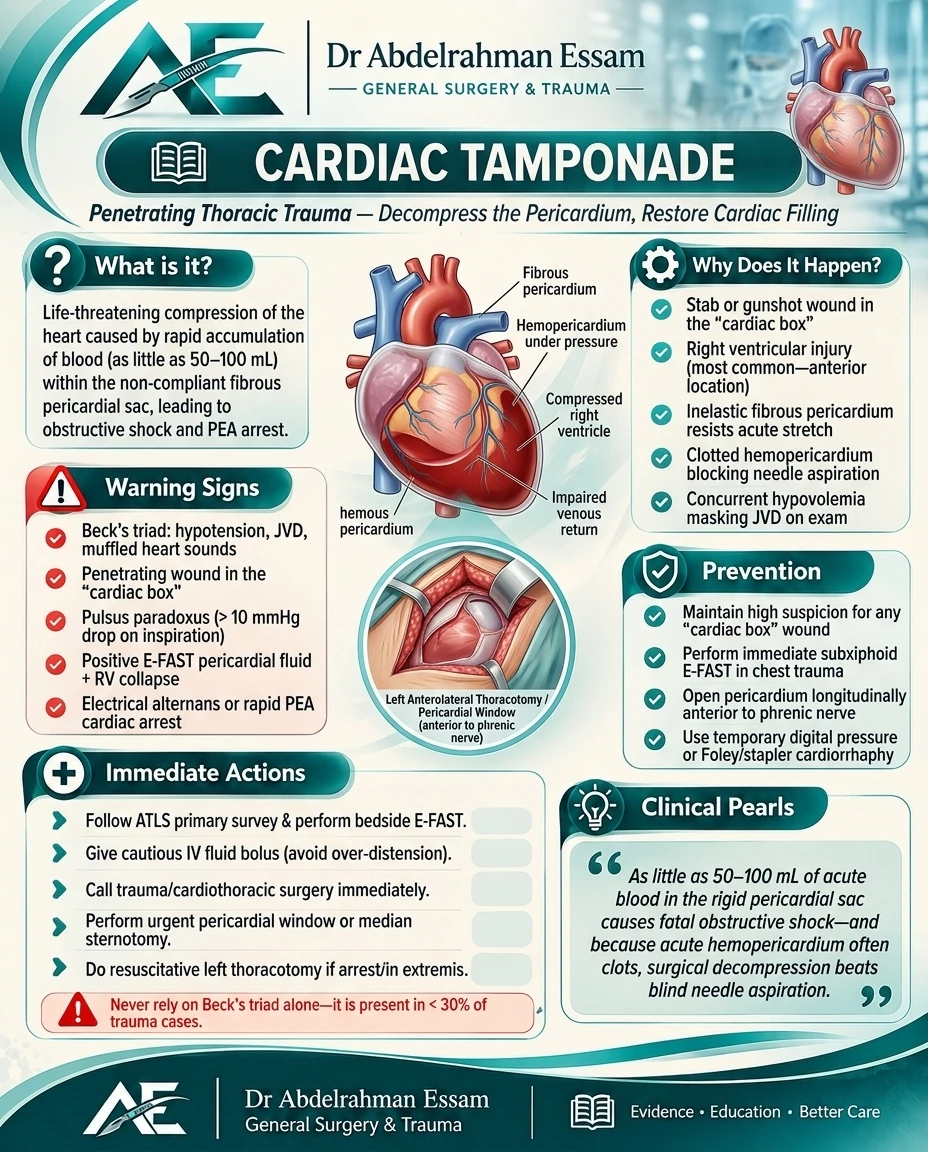
A hypothetical penetrating-trauma scenario illustrates why absent neck-vein distension and an incomplete Beck triad cannot reassure.
Hypothetical educational scenario
A patient arrives after a penetrating anterior chest injury with hypotension and tachycardia. Breath sounds are present, but neck veins are not distended.
This is a constructed teaching scenario, not a personal case report. Hemorrhagic shock, tamponade, tension pneumothorax, and other injuries must be considered in parallel. [1]
Understand the physiology
Blood accumulating within the pericardium can limit cardiac filling and cause obstructive shock. The effect depends on the speed of accumulation and pericardial compliance, not a fixed volume that applies to every patient.
Concurrent hypovolemia can obscure neck-vein distension, and the full Beck triad is often absent in trauma. [1]
Use rapid bedside assessment
E-FAST can identify pericardial fluid during the primary survey and support urgent decisions. A negative examination does not exclude every cardiac injury, especially when blood decompresses elsewhere or image quality is limited.
CT may help selected stable patients, but should not delay operative care in an unstable patient with a concerning pattern. [1]
Mobilize definitive treatment
Traumatic tamponade may involve clotted blood and an ongoing cardiac wound. Surgical decompression and control of the injury are therefore often required.
Pericardiocentesis may be a bridge in selected circumstances when definitive care is unavailable or delayed, but it may fail to evacuate clot and does not repair the injury. Airway and resuscitation plans must account for the effect of positive pressure on venous return. [1]
The operative pathway is context-dependent
Sternotomy, thoracotomy, and selected pericardial-window strategies depend on stability, injury pattern, and expertise. Resuscitative thoracotomy is reserved for patients meeting trauma-system criteria, not all penetrating chest injuries or every traumatic arrest.
The safe principle is early activation of a capable trauma team and rapid control of a reversible cause of shock. [1]
Practical Surgical Pearls
- An incomplete classic triad does not exclude tamponade after chest trauma.
Common Pitfalls
- Treating a fixed pericardial blood volume or one ultrasound sign as the whole diagnosis.
Key Takeaways
- Recognize the physiology and get definitive surgical capability involved early.
Educational content for healthcare learners and professionals, not individualized medical advice. Sources checked 22 November 2026. Recommendations may change; consult the full source and current local guidance. This is an editorial evidence review, not independent clinical peer review.