
Nutrition in the surgical ICU: feed early, advance safely
A practical, evidence-based surgical review
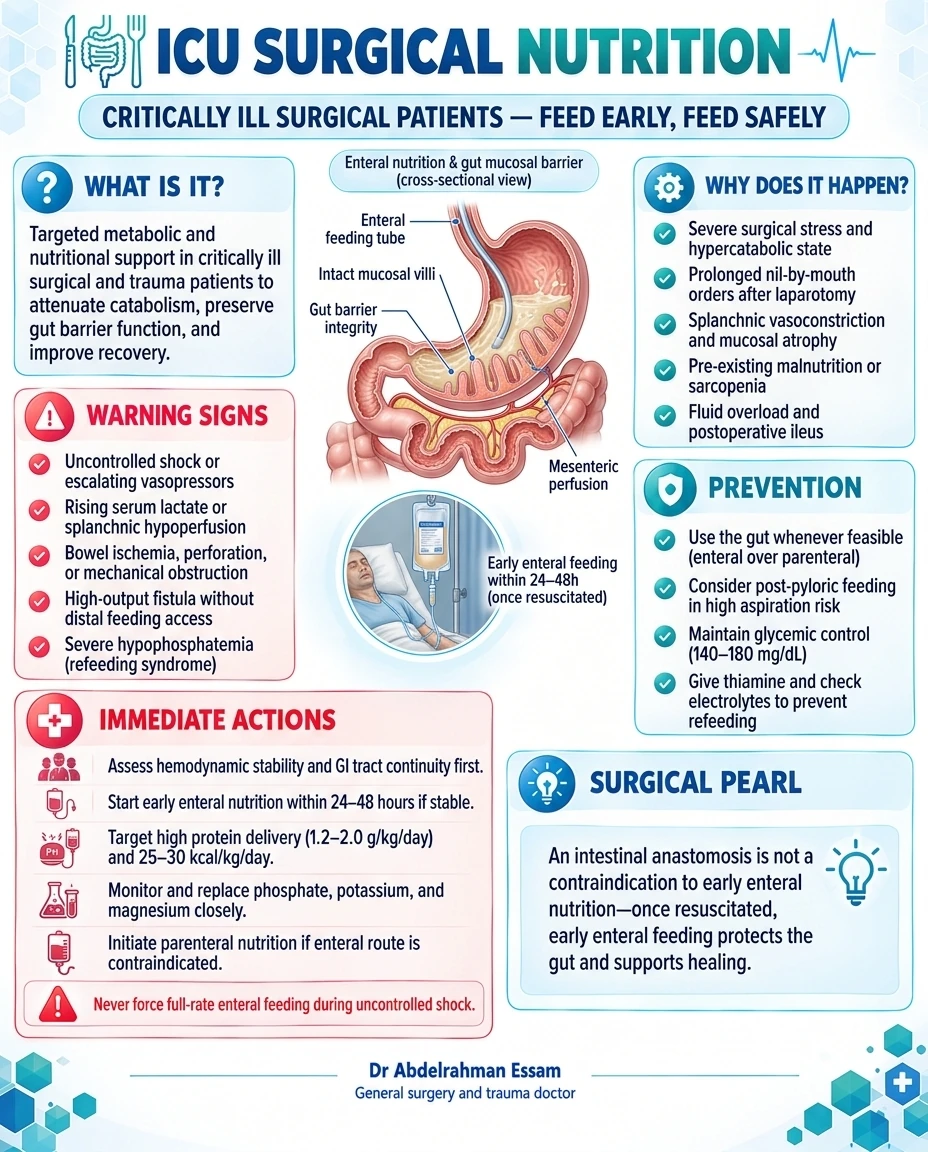
Early enteral nutrition is often appropriate after resuscitation, but full feeding during uncontrolled shock is not the goal.
Timing follows physiology
Critically ill surgical patients need an individualized nutrition plan. Enteral nutrition is generally preferred when the gastrointestinal tract can be used safely, and early initiation is often possible within 24 to 48 hours.
However, uncontrolled shock, suspected intestinal ischemia, or mechanical obstruction can make feeding unsafe. An arbitrary clock should not replace perfusion assessment.
[1,2]
Vasopressors are not a yes-or-no rule
The trend in support requirements and signs of adequate perfusion are important. A patient on stable or decreasing support after resuscitation differs from one with escalating vasopressors and worsening lactate.
The literature does not supply one universally safe vasopressor threshold for every patient. Begin cautiously when appropriate and watch for intolerance or new abdominal concerns.
[1,2]
Avoid the rush to full targets
Early critical illness includes endogenous energy production and changing metabolic demands. Immediate full-calorie delivery is not necessarily beneficial.
Start with a tolerable prescription and increase progressively, using indirect calorimetry where available and accounting for non-nutritional calories. Protein delivery also requires individualized planning rather than assuming that the highest dose is always best. [1]
Anticipate refeeding risk
A history of prolonged poor intake or severe malnutrition should trigger assessment for refeeding risk. Thiamine provision, cautious energy advancement, and monitoring of phosphate, potassium, magnesium, glucose, and fluid balance are important.
A single phosphate value alone does not establish or exclude refeeding syndrome. [1]
Choose access and alternatives deliberately
A fresh anastomosis is not automatically a contraindication to enteral feeding. The operation, bowel function, access, aspiration risk, and overall stability matter.
When enteral feeding is contraindicated or persistently insufficient, parenteral nutrition may be needed; its timing depends on nutritional risk and the expected course. A dietitian-led multidisciplinary plan is preferable to a fixed regimen copied between patients.
[1,2]
Practical Surgical Pearls
- Document the starting prescription, advancement plan, and daily monitoring.
Common Pitfalls
- Waiting for bowel sounds as the only condition for feeding.
- Forcing full-rate feeding during uncontrolled shock.
Key Takeaways
- Resuscitate, assess the gut, start appropriately, and reassess daily.
References
Educational content for healthcare learners and professionals, not individualized medical advice. Sources checked 22 November 2026. Recommendations may change; consult the full source and current local guidance. This is an editorial evidence review, not independent clinical peer review.