
Laparoscopic or open adhesiolysis: reading LASSO at five years
A practical, evidence-based surgical review
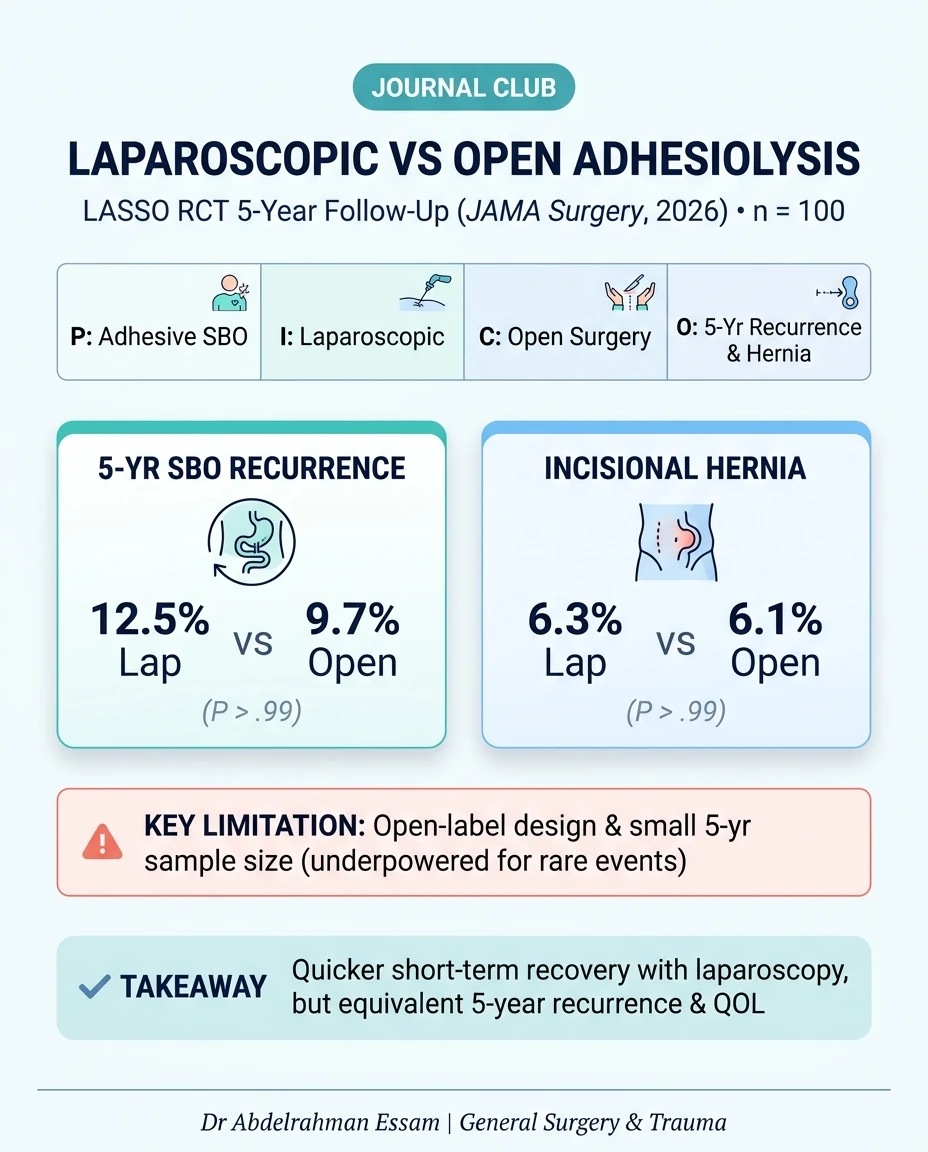
Early recovery benefits did not translate into demonstrated long-term superiority in this selected trial population.
PICO and study design
The LASSO trial compared laparoscopic with open adhesiolysis in selected adults with adhesive small-bowel obstruction that did not resolve with conservative treatment. The international, open-label trial was conducted in eight hospitals in Finland and Italy.
Of 104 randomized patients, 100 entered the reported analyses: 51 laparoscopic and 49 open. The present report addresses prespecified five-year outcomes. [1]
What the follow-up found
At five years, recurrent obstruction was reported in 4 patients (12.5%) in the laparoscopic group and 3 (9.7%) in the open group. Incisional hernia was detected in 2 patients in each group (6.3% and 6.1%, respectively).
The study found no statistically significant difference in these outcomes or measured quality of life. [1]
Why the denominators matter
The five-year recurrence percentages are not calculated from all 100 originally analyzed participants. Deaths and incomplete long-term assessments reduce the outcome-specific populations.
Event counts were small and confidence intervals wide. A non-significant result therefore means superiority was not demonstrated, not that the two procedures have been proven equivalent in every setting. [1]
Selection and applicability
Patients were selected to make a laparoscopic approach reasonably feasible. The results should not be generalized without caution to a severely distended abdomen, extensive adhesions, repeated prior laparotomies, or suspected ischemia.
The anatomy and safety of exposure matter more than maintaining a minimally invasive label. [1]
A practical journal-club conclusion
Laparoscopy may offer short-term recovery benefits in suitable patients, but these data do not establish lower five-year recurrence or hernia risk. Open surgery and timely conversion remain sound options.
Discuss outcomes in the context of selection, surgeon expertise, bowel-injury risk, and the limited precision of the long-term estimates. [1]
Practical Surgical Pearls
- Read absolute event counts alongside percentages and confidence intervals.
Common Pitfalls
- Interpreting P > .99 as proof that the operations are identical.
Key Takeaways
- Select the safest approach for the patient rather than promising an unproven long-term advantage.
Educational content for healthcare learners and professionals, not individualized medical advice. Sources checked 22 November 2026. Recommendations may change; consult the full source and current local guidance. This is an editorial evidence review, not independent clinical peer review.