
Preventing parastomal hernia: the Chimney Trial at three years
A practical, evidence-based surgical review
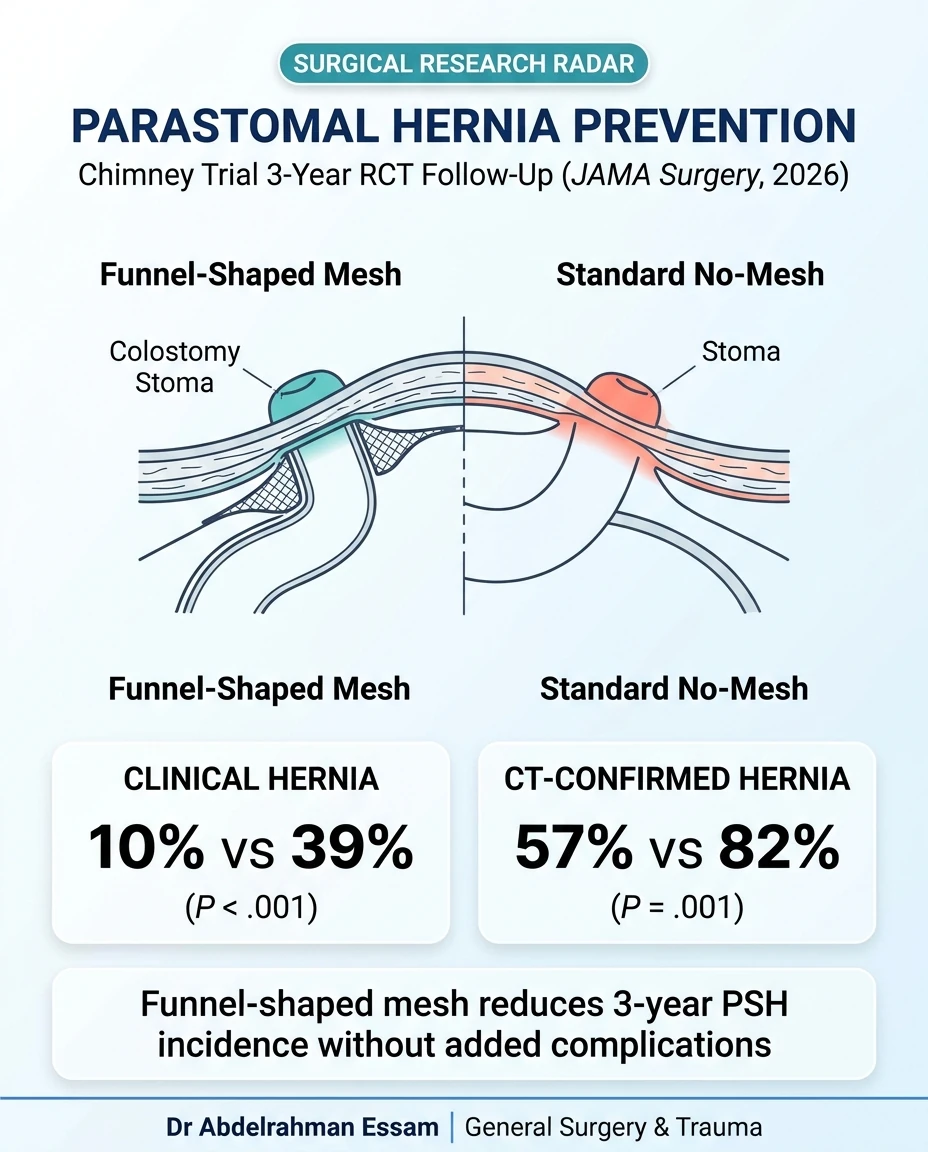
Funnel-shaped mesh reduced radiologic and clinical hernia in this study, but prevention was incomplete and follow-up matters.
Why this matters
A permanent colostomy can be followed by a parastomal hernia that affects appliance fitting, comfort, and quality of life. Prophylactic mesh aims to reduce this risk at the original operation.
Results depend on the mesh, its configuration, operative technique, and patient population, so one trial should not be treated as evidence for every type of mesh placement. [1]
Study and outcome populations
The three-year Chimney Trial report concerns patients undergoing surgery for rectal adenocarcinoma with permanent colostomy. The follow-up analysis included 50 patients in the funnel-shaped mesh group and 51 controls.
CT was available in 44 and 39 patients, respectively. The 101 patients in this analysis should not be described as the entire original randomized cohort. [1]
The three-year findings
CT-confirmed parastomal hernia occurred in 25/44 patients (57%) with mesh and 32/39 (82%) without mesh. Clinical hernia was recorded in 5/50 (10%) and 20/51 (39%), respectively.
Median hernia volume was 86.8 mL with mesh and 185.9 mL without mesh. The report did not find a significant increase in complications over this follow-up period. [1]
Interpreting benefit and safety
The radiologic and clinical endpoints tell different stories: an imaging-defined hernia is not necessarily symptomatic. Mesh reduced risk but did not eliminate hernias, including on CT.
A trial of this size cannot exclude rare mesh-related adverse events, and absence of a significant safety difference is not proof of zero harm. Attrition and different denominators also deserve attention. [1]
Implications for practice
The study supports discussing this specific preventive technique in appropriate permanent-colostomy surgery. The decision still needs to reflect operative context, contamination, patient risk, expertise, and the balance of expected benefit against mesh-related concerns.
These are trial findings in rectal cancer surgery, not a universal instruction for every stoma. Longer-term patient-centered outcomes remain important. [1]
Practical Surgical Pearls
- State whether a result is CT-defined or clinically diagnosed.
Common Pitfalls
- Equating fewer CT hernias with a proven benefit for every symptom or quality-of-life outcome.
Key Takeaways
- Promising preventive evidence should be interpreted with its population, technique, denominators, and follow-up.
References
Educational content for healthcare learners and professionals, not individualized medical advice. Sources checked 22 November 2026. Recommendations may change; consult the full source and current local guidance. This is an editorial evidence review, not independent clinical peer review.