
Sigmoid volvulus: decompression is a bridge to a recurrence plan
A practical, evidence-based surgical review
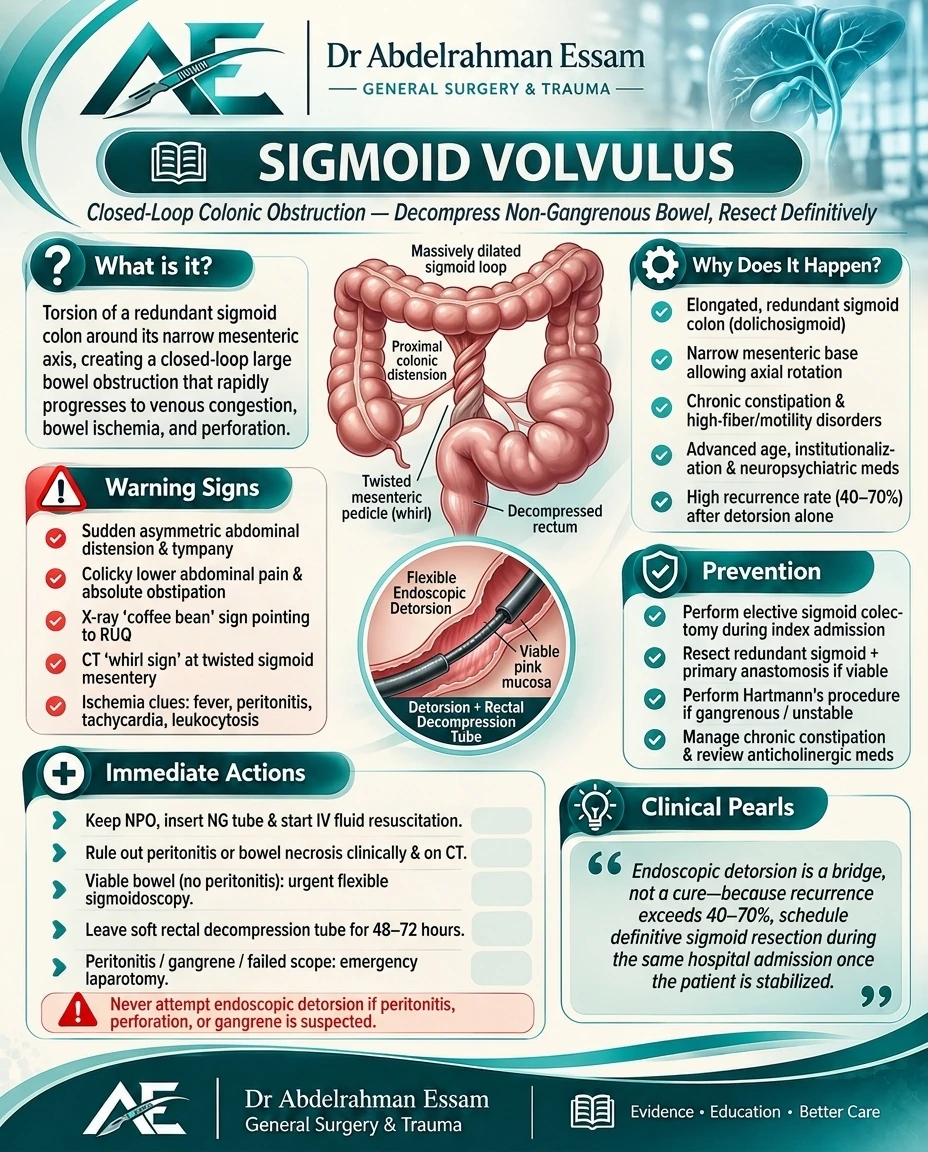
Viable bowel may be decompressed endoscopically. Ischemia, perforation, or failed detorsion changes the pathway to urgent surgery.
Recognize a closed-loop problem
Sigmoid volvulus occurs when a redundant sigmoid colon twists around its mesenteric axis. Distension, pain, and obstipation are common, while vomiting may occur later.
Chronic constipation, impaired mobility, and neurologic or psychiatric disease are relevant contexts, but the diagnosis should be based on the full clinical and imaging assessment. [1]
Assess viability as well as the diagnosis
Plain radiography may show a classic coffee-bean configuration. Contrast-enhanced CT is useful when diagnosis is uncertain or ischemia or another cause is suspected.
Peritonitis, shock, free air, or other evidence of compromised bowel demands urgent escalation. A normal lactate does not reliably exclude ischemia. [1]
When endoscopic detorsion fits
In the absence of suspected ischemia or perforation, urgent flexible endoscopic detorsion is recommended as an initial treatment. The mucosa should be assessed, and a decompression tube can help maintain decompression.
Successful passage of the scope does not remove the need to watch for deterioration or confirm a subsequent definitive plan. [1]
When resection is urgent
Failed endoscopic detorsion, non-viable colon, and perforation are indications for urgent sigmoid resection. The choice of primary anastomosis, diversion, or end colostomy depends on physiology, contamination, bowel condition, and overall operative risk.
Gangrene does not translate into one compulsory operation for every patient, but instability can make an anastomosis unsafe. [1]
Plan for recurrence during the index admission
After detorsion alone, recurrence is common; WSES reports rates of 45% to 71% with conservative management. The guideline recommends offering sigmoid colectomy as early as possible, including during the index admission, when the patient is fit.
Prohibitive operative risk requires a documented individualized discussion, potentially including selected endoscopic fixation approaches. Discharge without a recurrence plan is not definitive care. [1]
Practical Surgical Pearls
- After successful detorsion, ask what prevents the next episode.
Common Pitfalls
- Attempting endoscopic detorsion when perforation or non-viable bowel is suspected.
Key Takeaways
- Separate emergency decompression from definitive recurrence prevention.
Educational content for healthcare learners and professionals, not individualized medical advice. Sources checked 22 November 2026. Recommendations may change; consult the full source and current local guidance. This is an editorial evidence review, not independent clinical peer review.