
Small-bites fascial closure: the long view from STITCH
A practical, evidence-based surgical review
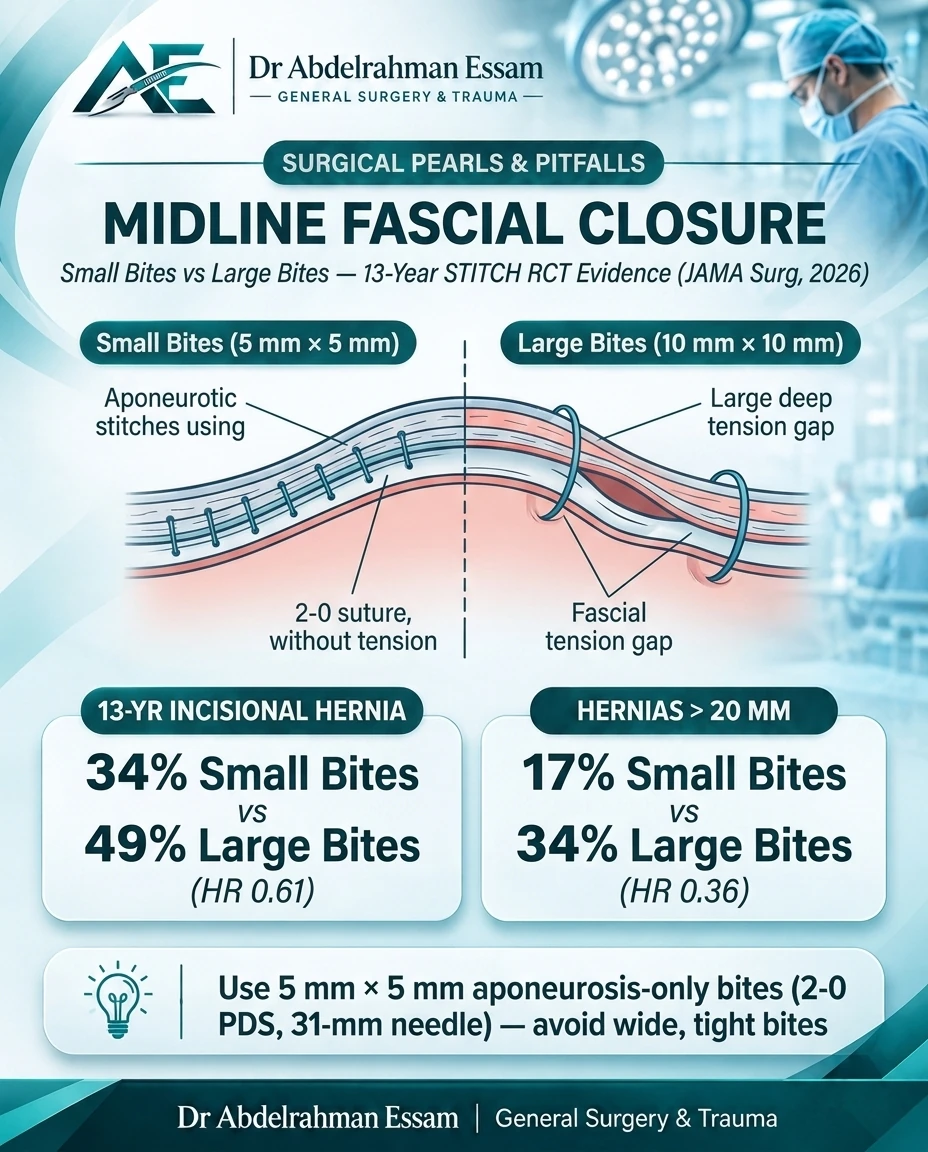
Thirteen-year follow-up supports careful small-bites closure after elective midline laparotomy, while showing that hernia risk remains.
The question at closure
The final fascial closure is an important part of an abdominal operation, not an afterthought. STITCH compares two continuous closure techniques and provides unusually long follow-up.
The relevant population was elective midline laparotomy, so extrapolation to an open abdomen or a swollen emergency abdomen needs caution. [1]
Technique tested
The trial compared small bites of 5 mm by 5 mm using polydioxanone 2-0 on a 31-mm needle against large bites of 10 mm by 10 mm using looped polydioxanone on a 48-mm needle. This is a comparison of technique packages, not a study isolating bite spacing from needle and suture characteristics.
Gentle fascial apposition is the goal; the illustration is not a measurement guide. [1]
Long-term results
The original study randomized 559 patients. At 13 years, cumulative incisional-hernia incidence was 34% with small bites and 49% with large bites (hazard ratio 0.61; 95% CI 0.43 to 0.86).
Hernias wider than 20 mm occurred with cumulative incidences of 17% and 34%. Mean hernia width at final follow-up was 25 mm versus 43 mm.
Hernia repair rates were similar. [1]
What this does and does not establish
The reduction persisted over long follow-up, but small bites did not prevent all hernias. Cumulative incidence estimates incorporate time-to-event methods and competing risks; they are not simply the proportion found at a single final clinic visit.
Long-term mortality, imaging availability, and follow-up completeness are relevant to interpretation. [1]
Bringing evidence into the operating room
Use an agreed closure protocol, suitable material, and deliberate attention to tissue handling and tension. Teach the technique directly and audit its use.
The result should not be simplified into a promise that an individual patient will avoid hernia, nor used to force closure when physiology or abdominal-wall tension makes primary closure unsafe. [1]
Practical Surgical Pearls
- Describe both the bite dimensions and the suture used in the trial.
Common Pitfalls
- Calling a 13-year cumulative estimate a complete follow-up examination of all 559 patients.
Key Takeaways
- A simple technical choice can improve long-term outcomes without eliminating other hernia risks.
Educational content for healthcare learners and professionals, not individualized medical advice. Sources checked 22 November 2026. Recommendations may change; consult the full source and current local guidance. This is an editorial evidence review, not independent clinical peer review.