
Strangulated abdominal-wall hernia: recognize ischemia and inspect viability
A practical, evidence-based surgical review
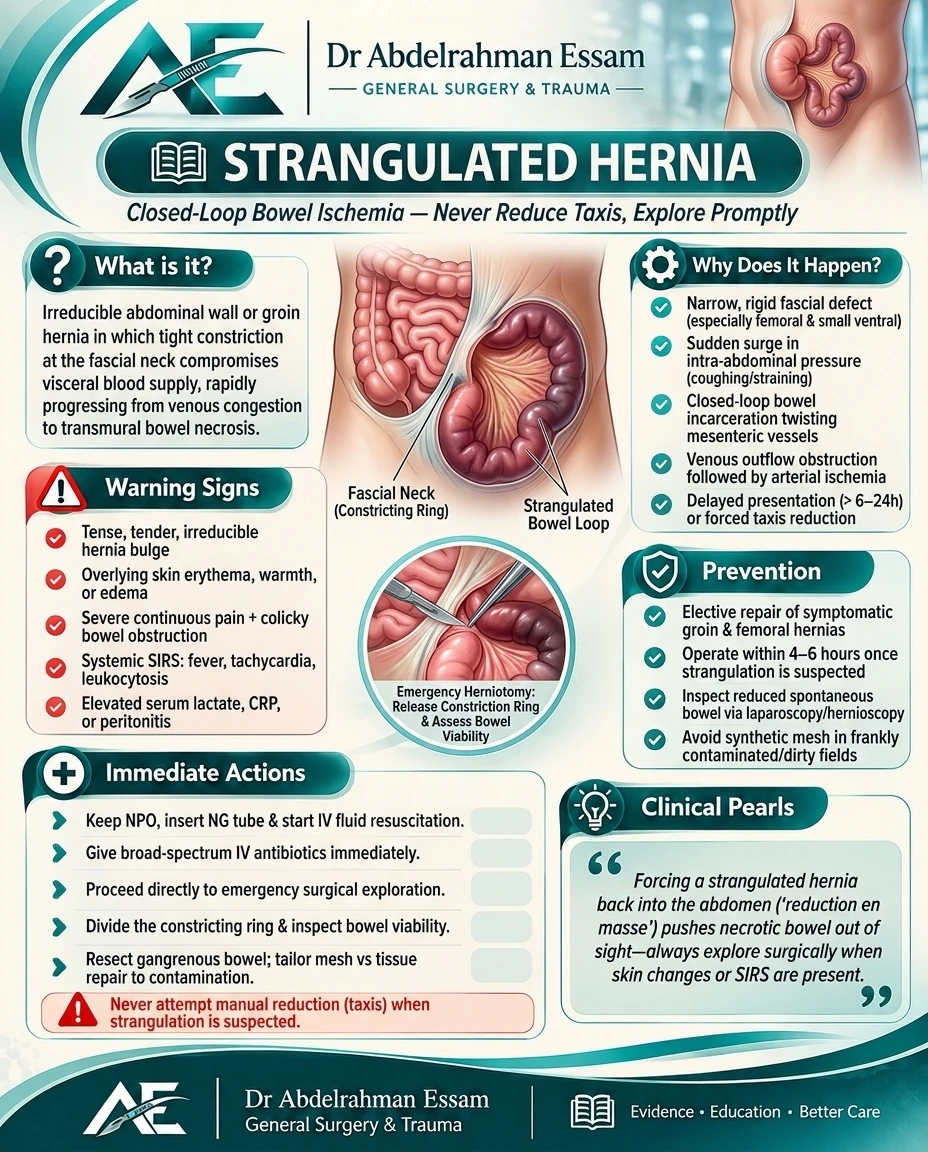
A painful irreducible hernia with concern for ischemia needs urgent surgical assessment. Repair strategy depends on contamination and patient condition.
Distinguish the terms
An incarcerated hernia is irreducible; a strangulated hernia has compromised blood supply to its contents. The two terms are not synonyms.
Persistent pain, tenderness, skin change, obstruction, systemic illness, or peritonitis should raise concern for ischemia, but no single laboratory marker reliably establishes or excludes it. [1]
Why delay is dangerous
Venous obstruction and edema at the hernia neck can progress to impaired arterial flow, bowel necrosis, and perforation. Femoral hernias and narrow defects deserve particular attention.
A Richter hernia can compromise part of the bowel wall without producing complete obstruction, so ongoing stool passage is not sufficient reassurance. [1]
Assessment and source control
Resuscitation, analgesia, decompression when needed, antibiotics when indicated, and urgent surgical planning proceed together. Imaging can help in a stable uncertain presentation, but it must not delay treatment when strangulation is strongly suspected.
Manual reduction is inappropriate when ischemia or peritonitis is suspected. [1]
Inspect the bowel and tailor the repair
Operative assessment establishes viability and whether resection is necessary. If the hernia reduces before inspection, the team must consider how to assess the previously trapped bowel.
Mesh decisions depend on wound class, contamination, defect, physiology, and expertise. The cited WSES guideline supports synthetic mesh in clean settings and selected clean-contaminated repairs; it does not reduce contaminated or dirty surgery to one universal material choice. [1]
A newer ventral-hernia qualification
The 2026 EHS guideline specifically addresses emergency primary ventral and incisional hernias in adults. For defects amenable to direct closure, it suggests mesh-based rather than suture-only repair across contamination grades, while large defects not amenable to closure may need a staged approach.
These recommendations do not automatically apply to every groin hernia, and contamination must still be interpreted with physiology, source control, and reconstructive feasibility. A blanket prohibition on permanent synthetic mesh in every contaminated field is therefore too simplistic. [2]
Follow-through matters
Document bowel findings, contamination, repair material, and the plan for wound and hernia follow-up. Persistent pain or illness after apparent reduction requires reassessment, because disappearance of the external bulge does not by itself establish bowel viability.
Emergency repair decisions should preserve both immediate safety and future reconstructive options. [1]
Practical Surgical Pearls
- Irreducibility describes the hernia; strangulation describes its blood supply.
Common Pitfalls
- Forceful reduction when bowel ischemia is a concern.
- Using a normal lactate to rule out threatened bowel.
Key Takeaways
- Recognize ischemic risk early and match the operation to what is found.
References
Educational content for healthcare learners and professionals, not individualized medical advice. Sources checked 22 November 2026. Recommendations may change; consult the full source and current local guidance. This is an editorial evidence review, not independent clinical peer review.