
Meaningful surgical mentorship: autonomy, support, and limits of the evidence
A practical, evidence-based surgical review
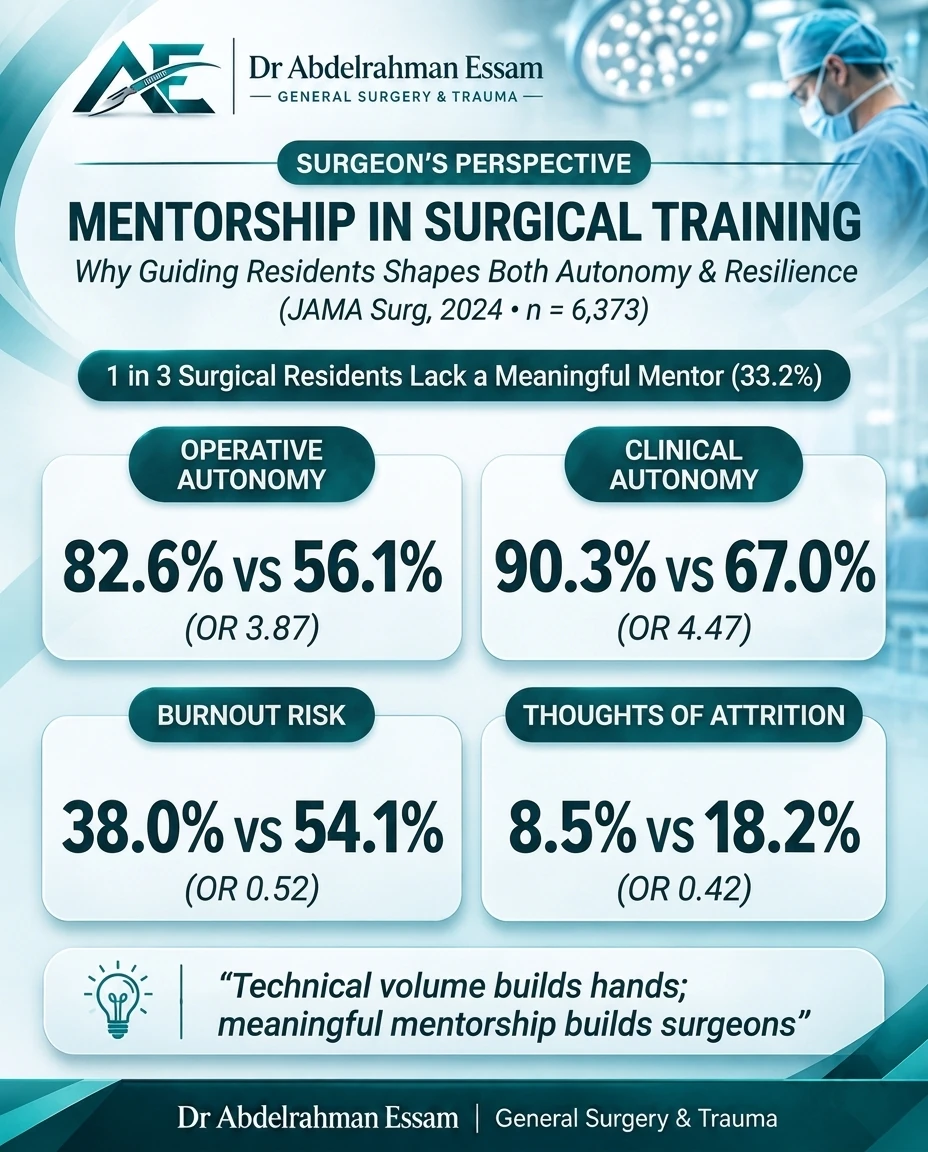
A national resident survey links mentorship with better educational and wellness measures, without proving causation.
Beyond the case log
Operative experience matters, but training also depends on feedback, graduated responsibility, and the ability to ask for help. Meaningful mentorship can connect these parts of training.
It should support safe development rather than create pressure to operate without appropriate supervision. This is an educational reflection on published evidence, not a claim about personal training experiences. [1]
What the survey measured
A national US study surveyed 6,373 clinically active general surgery residents across 301 programs. About one-third, 33.2%, reported lacking meaningful mentorship.
Mentorship was not distributed equally across resident groups, raising questions about access and inclusion within training systems. [1]
The observed associations
Residents reporting meaningful mentorship also reported greater clinical autonomy (90.3% versus 67.0%), operative autonomy (82.6% versus 56.1%), and career satisfaction (87.8% versus 67.3%). Burnout was less frequently reported (38.0% versus 54.1%), as were thoughts of attrition (8.5% versus 18.2%).
These are associations in survey responses, not effects established by random assignment. [1]
Why causal language would be misleading
A supportive program may produce both better mentorship and better wellness. Residents with better experiences may also be more likely to identify someone as a mentor.
The cross-sectional design cannot establish which came first or remove every confounder. It is therefore inaccurate to say the study proved mentorship reduced burnout by a specified amount. [1]
A practical reflection for educators
The findings make a case for paying attention to who has access to support, not simply assuming relationships develop automatically. Regular conversations, useful feedback, and explicit discussion of professional goals are reasonable ways to structure that support.
These are practical suggestions, not a tested intervention from this survey. Mentorship should complement fair assessment, workload reform, and formal support services rather than replace them. [1]
Practical Surgical Pearls
- Ask whether every trainee can identify a trusted source of constructive support.
Common Pitfalls
- Treating observational percentages as proof of a treatment effect.
Key Takeaways
- Value mentorship while addressing the wider training environment.
Educational content for healthcare learners and professionals, not individualized medical advice. Sources checked 22 November 2026. Recommendations may change; consult the full source and current local guidance. This is an editorial evidence review, not independent clinical peer review.